
Is the Salt Rock Off-Ramp an Accident Waiting to Happen?
by I Love Ballito Writer · · 7 min read
The short version
- At busy times, cars waiting to leave the N2 at Salt Rock queue back onto the freeway, standing in the slow lane and on the shoulder while traffic passes at highway speed.
- Ward 22 councillor Privi Makhan has escalated the signal timing to the KZN Department of Transport and asked for extra Road Traffic Inspectorate officers at peak times.
- The new N2 Sheffield interchange should take some traffic off Salt Rock Road. Construction is targeting completion before the end of 2026, but no opening date has been confirmed.
Traffic at the Salt Rock interchange has been frustrating motorists for years. The difference now is that the congestion is no longer contained to the local road network.
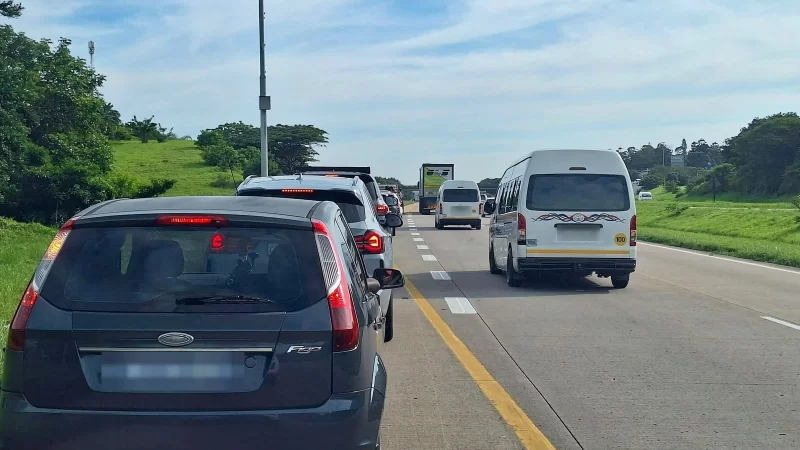
During busy periods, vehicles waiting to leave the N2 are queuing back onto the freeway. Motorists are coming to a standstill in the slow lane and, at times, along the shoulder while traffic continues past at highway speed.
That changes the issue completely.
This is no longer simply a long wait to reach Salt Rock. It is a road-safety risk created by a local intersection that can no longer reliably process the volume of traffic arriving from a national freeway.
A recent public discussion about the interchange drew more than 300 reactions and 150 comments. Residents described daily congestion, vehicles forcing their way into the queue, sudden braking and several near misses. One motorist said she had already been struck from behind while waiting to take the off-ramp.
The frustration is widespread, but the causes are more complicated than one badly timed traffic light.
Growth has overtaken the road network
Salt Rock, Sheffield Beach and the surrounding North Coast have experienced substantial residential and commercial growth.
New estates have brought investment, homes and economic activity, but they have also placed more vehicles onto a road system designed for a much smaller community.
The Salt Rock interchange now carries traffic moving between the N2, Salt Rock Road, Sheffield, the R102 and the coastal developments. During peak periods, much of that traffic is funnelled through the same intersections.
This pressure is not new. A traffic assessment conducted in 2016 already found that sections of the interchange were operating at the poorest recognised service level during morning and afternoon peaks, with long queues recorded.
A decade of additional development has followed.
The immediate problem may appear at the off-ramp, but it reflects a broader challenge facing the North Coast: development has moved faster than the supporting transport network.
The traffic lights are part of a larger system
Many residents believe that the green-light phase at the top of the off-ramp is too short to clear the queue.
Signal timing may certainly be contributing to the problem. If vehicles arrive from the N2 faster than the intersection releases them, the queue will continue growing until it reaches the freeway.
Ward 22 councillor Privi Makhan has confirmed that complaints about the signal timing have been escalated to the KwaZulu-Natal Department of Transport. She has also requested additional Road Traffic Inspectorate personnel during peak periods to supplement KwaDukuza Municipality’s traffic deployment.
Changing the timing, however, is not as simple as leaving one light green for longer.
Traffic released from the off-ramp must still be absorbed by Salt Rock Road and the surrounding intersections. Giving one movement more time can cause congestion elsewhere unless the signals are assessed and coordinated as a network.
That wider review is what is needed. The question should not only be whether the off-ramp light stays green long enough, but whether the sequence across the interchange is still appropriate for current traffic volumes.
Driver behaviour is making a difficult situation more dangerous
The road layout and traffic volume create the queue. Poor driving behaviour increases the danger.
Residents frequently report motorists passing the waiting line and then stopping in the slow lane while attempting to force their way back into the queue. This causes sudden braking for drivers continuing north and interrupts the flow of freeway traffic.
More disciplined driving would reduce some of the immediate risk, but enforcement cannot solve the capacity problem on its own.
Even a perfectly orderly queue is unsafe if it reaches a live freeway lane.
Visible traffic enforcement during peak periods could discourage queue-jumping and help manage the intersection, but it should be regarded as an interim safety measure rather than the long-term answer.
Too many authorities, one problem
Responsibility for the area is divided across different levels of government.
SANRAL manages the N2 and the national-road portions of the interchange. The KwaZulu-Natal Department of Transport is responsible for Salt Rock Road and the traffic signals, while KwaDukuza Municipality manages surrounding local roads and provides local traffic services.
Each authority may be responsible for a different part of the system, but motorists experience it as one interchange.
That division makes coordination essential. It can also make problems slower to resolve when maintenance, signal timing, enforcement and road design fall under different organisations.
The public should not need to understand which authority owns a particular traffic light before a clear safety concern receives attention.
Will the Sheffield interchange provide relief?
The new N2 Sheffield interchange is the most significant future intervention.
The project will add south-facing on- and off-ramps north of Salt Rock, creating another access route for Sheffield and nearby developments. By diverting some traffic away from the existing interchange, it should reduce the number of vehicles dependent on Salt Rock Road.
Construction is targeting completion before the end of 2026. The completed work must still receive SANRAL approval before opening, and no official opening date has been confirmed.
It should provide welcome relief, but it would be risky to treat the new interchange as the complete solution.
Salt Rock will continue growing, and the existing interchange will remain an important connection between the N2, the R102 and the coast. Any reduction in traffic could eventually be absorbed by further development if infrastructure planning does not keep pace.
What can be done now?
The immediate priority should be preventing queues from forming in an active freeway lane.
That requires a coordinated assessment of current traffic volumes, signal timing and queue lengths during both morning and afternoon peaks.
Practical short-term measures could include:
- Adjusting and coordinating traffic-signal timing during peak periods.
- Deploying traffic officers to control queue-jumping and manage the intersection.
- Providing earlier warning when traffic is backed up onto the N2.
- Reviewing lane markings and the available stacking distance on the off-ramp.
- Establishing a clear operational plan between SANRAL, KZN Transport and KwaDukuza Municipality.
- Giving the public a confirmed update on the Sheffield interchange and its expected opening.
Longer-term planning must consider whether the existing interchange can continue accommodating the growth expected across Salt Rock and Sheffield.
The North Coast’s expansion is a sign of confidence in the area. But growth without infrastructure eventually produces a cost, whether measured in lost time, daily frustration or increased risk.
At the Salt Rock off-ramp, that cost is now being carried by motorists sitting stationary on the N2 and hoping that every approaching driver sees the queue in time.
Questions people ask about the Salt Rock off-ramp
Who is responsible for the Salt Rock interchange?
Three authorities share it. SANRAL manages the N2 and the national-road portions of the interchange, the KwaZulu-Natal Department of Transport is responsible for Salt Rock Road and the traffic signals, and KwaDukuza Municipality manages the surrounding local roads and provides local traffic services.
Why does the off-ramp queue reach the N2?
When vehicles arrive from the N2 faster than the intersection at the top of the ramp releases them, the queue keeps growing until it reaches the freeway. Growth across Salt Rock and Sheffield has added traffic, and queue-jumping from the slow lane makes it more dangerous.
When will the Sheffield interchange open?
Construction is targeting completion before the end of 2026. The finished work must still be approved by SANRAL before it opens, and no official opening date has been confirmed.
Is the Salt Rock congestion a new problem?
No. A traffic assessment in 2016 already found sections of the interchange operating at the poorest recognised service level in the morning and afternoon peaks, with long queues, and a decade of development has followed.
Photo: Nolan Pillay. With thanks to Nolan Pillay and everyone who shared their experience of the off-ramp in the comments on his Facebook post.
The division of responsibility between SANRAL, the KZN Department of Transport and KwaDukuza Municipality matches the North Coast Courier’s reporting on the interchange’s traffic lights in 2025.
Enjoyed this? See more from I Love Ballito in your Google results.

READ MORE
The Nobel Peace Prize Story Just Up the Road from Ballito
by I Love Ballito Writer · November 12, 2026
What's On in Ballito and the KZN North Coast: October to December 2026
by I Love Ballito Writer · October 13, 2026

What's New on the KZN North Coast: Everything That Opened in 2026
by I Love Ballito Writer · October 13, 2026